Royal Intrigue and a Real Cinderella: Inside Tsar Mikhail Romanov’s Bride Selection
The historical unraveling of Tsar Mikhail Romanov’s bride selection reveals how 17th-century Russian court dynamics mixed political sabotage with an unexpected fairytale outcome. Following the severe chaos of the Time of Troubles, the young ruler needed a healthy heir. His search for a tsarina turned into a dramatic saga involving poisoned candidates, manipulative boyars, and an impoverished noblewoman who eventually won the royal crown.
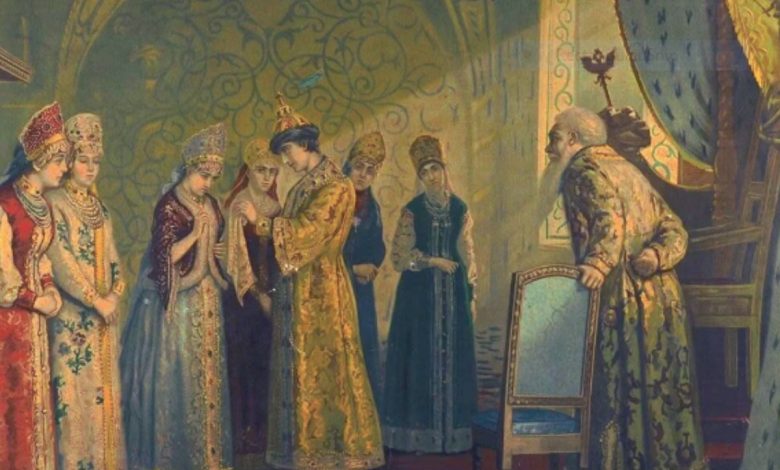
In 17th-century Muscovy, selecting a tsarina was rarely a simple affair of the heart. The tsarist court relied on a Byzantine-inspired ritual known as the “smotriny” or bride-show. Envoys traveled throughout the realm, inspecting hundreds of unmarried noble maidens for physical health, family reputation, and moral standing. Rulers intentionally married domestic noblewomen rather than foreign princesses to preserve Orthodox religious purity and prevent European political entanglements.
Shortlisted candidates were brought directly to the Kremlin in Moscow, where they lived in sequestered quarters. Royal physicians and court matrons subjected the women to rigorous physical examinations to verify their fertility and overall health. Once the final group was presented, the tsar signaled his choice by handing his favored maiden an embroidered handkerchief and a golden ring.
The initial attempt at Tsar Mikhail Romanov’s bride selection in 1616 ended in bitter heartbreak and political corruption. Out of nearly 500 applicants, 20-year-old Mikhail selected Maria Khlopova to become his tsarina. She adopted the royal title and moved into the palace quarters, awaiting the official wedding ceremony.
However, powerful court factions viewed her family’s sudden rise as a threat to their own influence. Powerful nobles secretly poisoned Maria’s food, causing her to suffer violent fainting spells and vomiting. Court physicians under boyar control declared her chronically ill and infertile, resulting in Maria and her family being banished to Siberia.
A decade after the Khlopova scandal, the tsar conducted another bride-show in 1626. Determined not to let corrupt courtiers dictate his personal life, Mikhail looked past the wealthy candidates thrust forward by influential boyar families. Sitting among the prospective brides was Evdokiya Streshneva, an impoverished noblewoman who had arrived merely as an attendant to a wealthy relative.
Evdokiya’s modesty, genuine beauty, and lack of political connections immediately captured Mikhail’s attention. Defying the expectations of the court, he chose her as his bride, transforming her overnight from an obscure relative into the Tsarina of All Russia. Her humble background earned her historic comparison to Cinderella, as she entered the Kremlin without court backing or familial wealth.
The marriage between Tsar Mikhail and Evdokiya Streshneva proved to be a resounding success for the young Romanov state. Unlike previous candidates whose lives were upended by court intrigue, Evdokiya remained shielded from major scandals. She fulfilled her primary dynastic duty by giving birth to ten children, ensuring a clear line of succession.
Her eldest son, Alexis Mikhailovich, would eventually inherit the throne and solidify Romanov rule over Russia. This successful union demonstrated how Tsar Mikhail Romanov’s bride selection reshaped imperial politics by proving that a ruler could choose a modest bride to neutralize boyar rivalries. The practice of traditional bride-shows continued for decades, leaving a lasting mark on Russian royal history.