How Drinking Nearly Destroyed England
England was repeatedly devastated by epidemics, so plague, cholera, and smallpox were perceived by the islanders as a necessary evil until the end of the 19th century. But there were other epidemics in Foggy Albion, connected not with bacteria and viruses, but with greed, stupidity, and licentiousness of people. One of them, merciless and deadly, almost devastated the country in the 18th century, and the causative agent of the “disease” was … cheap gin.
The blood of drunken stabbings flowed through the streets, mothers sold children for a bottle, and the corpses of those killed and drunk to death were taken to cemeteries in whole carts. The poor suburbs of London became more dangerous than the Indian-infested prairies of the New World, and wealthy citizens preferred to move around surrounded by dense squares of heavily armed bodyguards. And it all started as usual – with good intentions. Until the early 18th century, the favorite drink of the British was beer. Ruddy yeomen worked on their farms, and they could only be lured into the slop-stinking gorges of the city streets during fairs and coronations.
Must Read: some Strange and Disgusting Facts About Victorian Britain
But in the 18th-century industrialization broke out and London, Liverpool, Birmingham, and other large cities began to turn into industrial centers. Plants and factories needed workers, and crowds of rural residents poured into the cities in search of a better life.
Hundreds of thousands of peasants gathered in London, whom the city devoured without a trace while growing into picturesque slums. At first, beer and cheap French brandy were drunk in the sewers of the capital, but everything changed after the Dutchman William of Orange became king. England became the best ally of Holland and the customs of this country began to actively penetrate into the life of the British. The once congenial French began to drift apart, aided by religious and political conflicts. Drinking brandy became unpatriotic and this alcohol gradually began to lose its popularity. Since whiskey was not yet held in high esteem, the place of the French drink was gradually taken by the Dutch gin.
The drink with an unusual smell of juniper fell in love with the British and kegs of gin took pride of place on the shelves of pubs and taverns. Everything could have been decorous, as before, if the British Parliament had not intervened in alcohol matters. As relations with France irrevocably deteriorated, the lords decided to finally squeeze brandy out of the English market and replace it with Dutch gin.
To do this, such a draconian duty was imposed on French brandy that this public drink in England became simply golden. At the same time, they put pressure on local brewers with requisitions, citing the fact that beer production transfers too much grain. But gin exporters and producers were given a “green road” by imposing symbolic taxes on them. Grain of the lowest quality was suitable for the production of gin, and even that spoiled in the bins of taxed brewers. Dutch liquor began to be produced on an industrial scale and grain, which was spared for beer, was not enough.
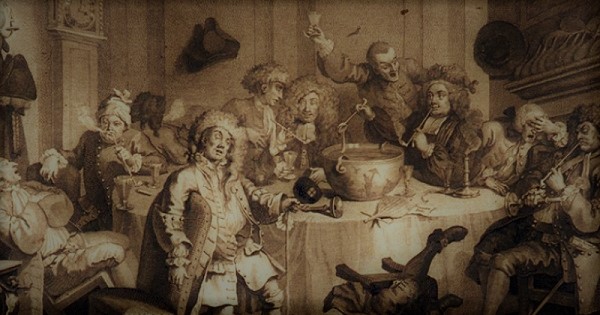
The London slums plunged into unrestrained drunkenness because gin cost mere pennies. The signboards of the London taverns of that time flaunted the tempting inscriptions: “Drunk for a penny, deadly drunk for two! Free Straw! Straw was needed by those who could not leave the drinking place with their feet, and there were many of them. The peasants who came to the capital in search of a better life had not tasted gin before and did not have the slightest drinking culture. Gin was served to them in pints, as beer is usually served, and the poor fellows were drunk in a matter of days. Gin in those days was made according to a simple technology imported from Holland. First, barley mash was distilled, as is done for whiskey, and then the composition was diluted with water and flavored with an aromatic set based on juniper berries. The resulting liquid was again distilled, turning into a fragrant drink with a strength of 30 degrees.
But this classic recipe soon began to be modernized, and as a result, gin began to be made from any rubbish. Sometimes even chicken manure and turpentine, which was added for strength, came into play. Sometimes the swill turned out so vile that they refused to drink it even for free. Then a little sugar was added to it and the consumer was immediately found. Since then, it has been believed that sweet gin is a low-quality product and an Englishman who respects himself and his drinking companions will not put such a drink on the table. From surrogate alcohol, people died, went crazy, and went to the most terrible crimes. Shame and a sense of self-preservation were lost – drunkards pawned clothes in taverns and froze in thousands in London lanes. Approximately the same thing happened in other large cities of the kingdom and in some small ones.
The well-worn inhabitants of London were shocked by the act of a certain Judith DeFore. This lady received clothes for her baby from a charitable organization, but she immediately drank them in a tavern and strangled the baby. She was hastily tried and hung up on the gallows, next to the same townspeople who had lost their human appearance due to alcohol.
The well-worn inhabitants of London were shocked by the act of a certain Judith DeFore. This lady received clothes for her baby from a charitable organization, but she immediately drank them in a tavern, and strangled the baby. She was hastily tried and hung up on the gallows, next to the same townspeople who had lost their human appearance due to alcohol.
As a result, Parliament, which recently promoted gin to the market, recognized it as “the main cause of all vices and debauchery committed among people of the lowest class.” In the 1730s, 20 years after the outbreak of a strange epidemic, Parliament decided to fight the phenomenon that it had created. Gin was subject to excise duties, taxes were raised, and illegal producers and traders began to be rounded up. But London could no longer live without gin, and representatives of its bottom began to actively resist. Stones were thrown at the policemen who went out on the raid, and state inspectors and informants were cut in the doorways.
A real rebellion began and the mob seriously planned to storm the Parliament, which prevented her from drinking. True, it did not come to this, but it was finally possible to calm down the inhabitants of the slums only after 20 years. If you think that it was a war of sobriety against vice, then you are deeply mistaken. In this war, two models of drunkenness fought to the death.
On the one hand, there were consumers of stinky gin, and on the other, lovers of traditional English beer. Gin with turpentine was a symbol of barbarism and poverty, and beer personified the middle class, loyal to the authorities and regularly attending church. So there was no talk about sobriety – one drink was again replaced with a battle with another, with an eye on someone’s interests.