Forgotten Pioneers: How Animals in Space Paved the Way for Human Exploration
The historic journey of Animals in Space laid the crucial scientific foundation long before human astronauts ever strapped into rockets to leave Earth’s atmosphere. During the mid-twentieth century space race, scientists relied on brave biological pioneers to test whether living organisms could survive intense cosmic radiation, extreme G-forces, and prolonged weightlessness in orbit.
In February 1947, the United States launched fruit flies aboard a captured German V-2 rocket to analyze radiation exposure at high altitudes. Reaching an altitude of 68 miles, the insects returned safely via parachute, proving that complex life could survive suborbital travel. Soon after, researchers sent small mammals, including rhesus monkeys and mice, to monitor cardiovascular responses under extreme flight conditions.
The Soviet Union selected stray street dogs for its space program, believing their survival instincts made them exceptionally resilient subjects. In November 1957, a stray named Laika captured global attention when she launched aboard Sputnik 2. Although she tragically succumbed to heat stress hours into the flight, her mission proved that living beings could endure orbital insertion.
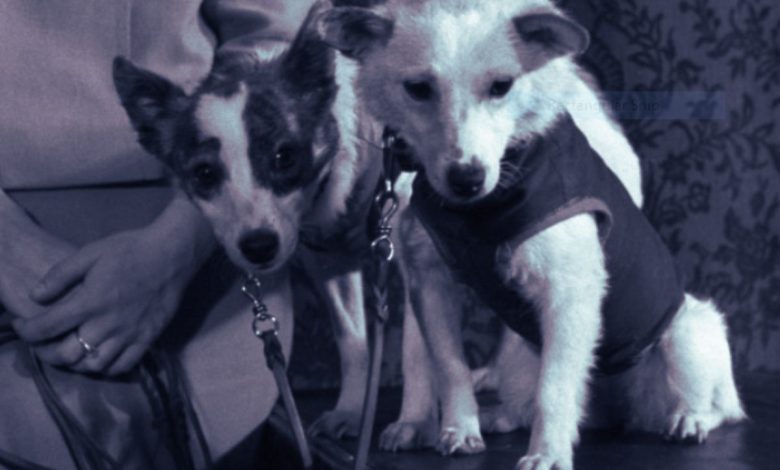
Three years later in August 1960, Soviet canines Belka and Strelka achieved an unprecedented milestone. Accompanied by forty mice, two rats, and several plants, they completed seventeen orbits before landing safely back on Earth. Strelka later gave birth to a healthy litter of puppies, demonstrating that orbital spaceflight caused no permanent damage to reproductive health.
Across the Atlantic, American engineers focused on testing cognitive performance during weightlessness. In January 1961, Ham the Chimp successfully pulled levers in response to light signals while aboard the Mercury-Redstone capsule. His successful suborbital flight gave NASA the confidence to launch Alan Shepard into space months later.
France joined the space race in 1963 by launching Félicette, a Parisian stray who became the first cat in space. Meanwhile, Soviet probes dispatched tortoises on circumlunar missions around the Moon in 1968, marking the first time living creatures orbited another celestial body.
As space technology matured, scientists shifted their focus from basic survival to studying long-term microgravity effects on biological systems. Today, research aboard the International Space Station uses tiny organisms like tardigrades, nematodes, and fruit flies to investigate muscle atrophy, bone density loss, and cellular repair mechanisms.
The sacrifices of early biological pioneers ultimately transformed aerospace engineering and medical safety protocols for future astronauts. While modern ethical standards have largely replaced mammals with cellular models and automated sensors, the courage of these early travelers remains immortalized in spaceflight history.