Can an Ape Become Human? The Tragic Life of Nim Chimpsky
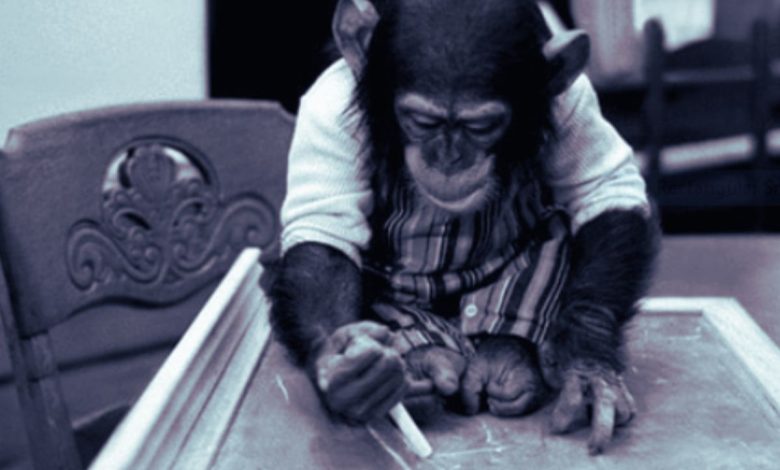
The tragic saga of Nim Chimpsky stands as one of the most controversial scientific experiments in modern history. Launched in the early 1970s by Columbia University psychologists, the groundbreaking study attempted to discover whether a chimpanzee could acquire human language when raised in a domestic family environment. What began as an ambitious linguistic milestone ended in heartbreaking emotional turmoil.
In late 1973, Columbia University psychologist Herbert Terrace launched Project Nim to challenge linguist Noam Chomsky’s landmark theory that language is uniquely hardwired into human DNA. Researchers deliberately named the infant chimpanzee Nim Chimpsky as a tongue-in-cheek pun on the famous academic. Scientists removed the newborn chimp from his mother at an Oklahoma primate center and handed him over to a surrogate family in New York City.
The infant ape grew up in a busy Manhattan brownstone, wearing clothes, eating human meals, and sleeping in a regular bed. Dozens of volunteer student trainers attempted to teach him American Sign Language in a domestic environment. The goal was to observe whether daily immersion in a human household would trigger natural grammatical comprehension.
As the young primate matured into a powerful juvenile, managing his wild instincts inside a residential home proved nearly impossible. The project moved Nim to a large mansion estate in Riverdale, where an ever-changing staff of caregivers struggled with his increasing aggression. Over four years, roughly sixty different people rotated through his life, destroying any possibility of stable emotional attachment.
Although the chimp learned over one hundred individual signs, project leader Herbert Terrace eventually reviewed videotapes and made a startling declaration. He concluded that the animal was not actually constructing spontaneous sentences or expressing creative ideas. Instead, the primate was simply copying trainer gestures to secure food, affection, and physical rewards.
When funding ran out and the project abruptly collapsed in 1977, researchers shipped the humanized animal back to a primate research facility in Oklahoma. The sudden transition from human homes to concrete cages devastated the young ape. Having spent his formative years believing he was human, he could no longer relate easily to other chimpanzees.
His ordeal worsened when a pharmaceutical lab bought him for medical experimentation, though public outrage ultimately forced his release. Activists rescued the traumatized animal and relocated him to Black Beauty Ranch, a sanctuary in Texas. He spent his final years there, carrying deep psychological scars until his death from a heart attack in 2000 at age 26.
The ultimate failure of the Nim Chimpsky experiment transformed how the global scientific community evaluates animal research ethics. Psychologists and bioethicists now cite the project as a cautionary tale against stripping intelligent social creatures of their natural environments. Attempting to force human social identity onto wild animals frequently inflicts lasting psychological harm without producing valid scientific breakthroughs.
Today, most primate researchers have abandoned attempts to teach human languages to apes. Instead, modern animal behaviorists focus on studying how primates naturally communicate in the wild using their own complex vocalizations and gestures. The story of this remarkable chimp remains an enduring symbol of scientific hubris and moral oversight.