Exploring the World’s Most Impressive Giant Earth Holes
Exploring the most impressive Giant Earth Holes across our planet reveals a breathtaking collision between natural forces and human industrial ambition. From deep Siberian diamond pits to terrifying desert craters that burn perpetually, these massive chasms offer a dramatic glimpse into Earth’s geology. Each giant crater tells a unique story of scientific wonder, environmental hazard, and sheer mechanical scale.
The Mirny diamond mine in Eastern Siberia stands as one of the most famous open-pit excavations in human history. Reaching a depth of over 500 meters and stretching more than a kilometer wide, the sheer suction created by air currents over the abyss once forced local authorities to ban helicopter flights directly above it. Further north, the Udachnaya pipe sits as another colossal diamond quarry, yielding billions of dollars in gems while pushing the limits of extreme polar mining technology.
Halfway across the world in South Africa, the Kimberley “Big Hole” tells a historical tale of the 19th-century diamond rush. Hand-dug by tens of thousands of miners using simple picks and shovels, workers extracted nearly 3,000 kilograms of diamonds before operations ceased. Today, the partially flooded pit serves as a landmark, preserving the memory of human labor and environmental transformation that shaped modern mining history.
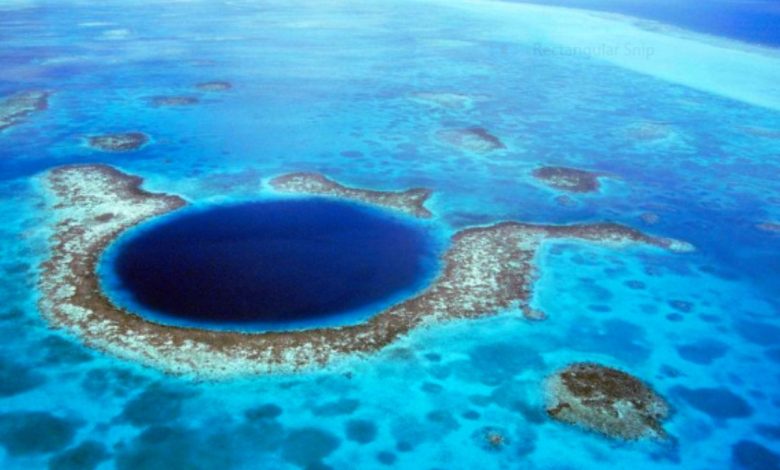
Beyond industrial mining, natural geology has crafted equally terrifying caverns beneath land and sea. The Great Blue Hole, situated off the coast of Belize, is a near-perfect circular submarine sinkhole measuring over 300 meters across and 124 meters deep. Attracting scuba divers from around the globe, this underwater abyss formed during prehistoric glacial ages when rising ocean levels flooded giant limestone caverns. These extraordinary Giant Earth Holes demonstrate how dramatically marine ecosystems adapt to prehistoric cave collapses.
On dry land, sudden urban collapses present a far more immediate threat to human settlements. The infamous 2010 Guatemalan sinkhole devoured a three-story factory and an entire city intersection during Tropical Storm Agatha. Caused by leaking sewer infrastructure dissolving weak volcanic ash deposits beneath the capital, this catastrophic collapse reminded the world how fragile city foundations can truly be under extreme weather conditions.
In the heart of Turkmenistan’s Karakum Desert lies the Darvaza Gas Crater, famously nicknamed the “Door to Hell.” Soviet geologists drilling for oil in 1971 accidentally breached a subterranean natural gas pocket, causing the ground beneath their rig to collapse into a gaping hole. Expecting the escaping methane to burn off in a matter of weeks, engineers set the pit ablaze, but the inferno has continued burning nonstop for over fifty years.
Equally mesmerizing are artificial water spillways like the Monticello Dam’s “Glory Hole” in California. Functioning as a giant drain for Lake Berryessa, this concrete funnel swallows tens of thousands of gallons of excess water per second during heavy rains. Though built entirely for flood control, the sight of a massive swirling vortex in the middle of a reservoir draws spectators fascinated by the engineering prowess required to control water pressure.
When evaluating the largest man-made excavations on Earth, Utah’s Bingham Canyon Mine easily claims a spot near the top. Operating for well over a century, this massive copper mine stretches nearly four kilometers wide and drops more than 1,200 meters into the Oquirrh Mountains. Visible even to astronauts in low Earth orbit, it remains an active industrial site pumping out critical metals for modern technology.
Whether created by open-pit mining or subterranean erosion, Giant Earth Holes serve as powerful reminders of planetary forces and human impact. As environmental monitoring improves, scientists continue studying these formations to better predict urban sinkholes and manage land restoration around abandoned industrial quarries globally.